
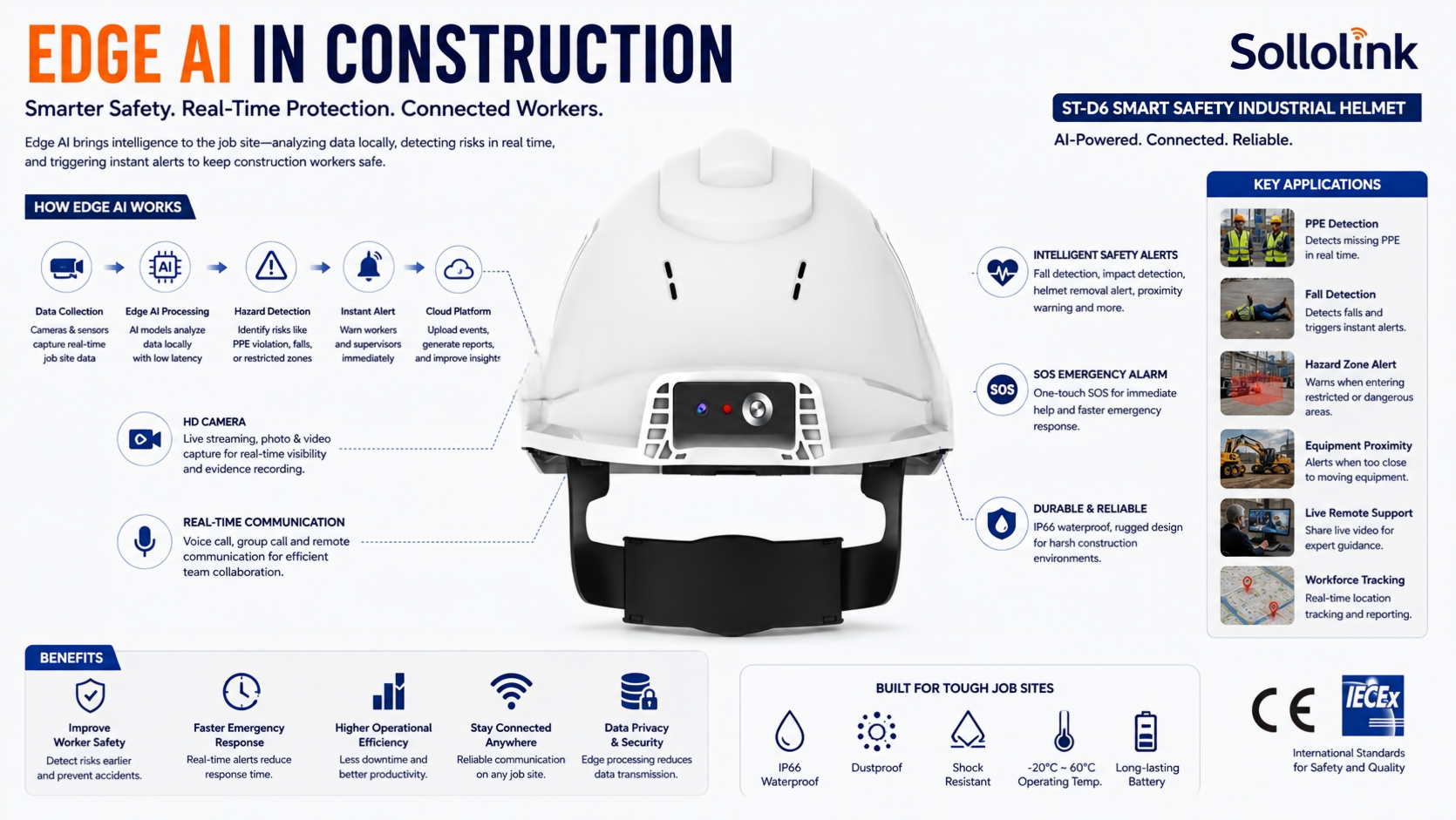
The Evolution of Construction Safety Management
Construction sites are high-consequence, rapidly shifting environments. Field personnel continuously navigate dynamic hazards—including high-G falls, high-voltage electrical proximity risks, heavy machinery clearance zones, and restricted area breaches.
Traditional safety management relies primarily on passive physical PPE, periodic manual site audits, and post-incident CCTV reviews. While foundational, these methods suffer from a core limitation: they are inherently reactive. They document accidents after they occur rather than preventing them in real time.
Edge AI in construction shifts safety management from post-incident reporting to real-time risk prevention. By running artificial intelligence models directly on localized edge nodes and smart wearables, Edge AI enables immediate hazard detection and sub-second alerting where the work actually happens.
#EdgeAIinconstruction #constructionsafetyAI#smartsafetyhelmet#PPEdetection#realtimehazarddetection
What Is Edge AI in Construction?
Edge AI combines artificial intelligence with edge computing. Instead of streaming massive volumes of raw video and sensor data over satellite or cellular connections to remote cloud servers, AI models process data locally on hardware deployed directly across the construction site.
The Construction Edge AI Stack: Smart Safety Helmets: Wearable edge devices with integrated optical cameras, IMUs, and GPS.
On-Site AI Gateways: Local micro-servers running computer vision for zone monitoring.
Industrial Vision Cameras: Fixed-site cameras executing real-time PPE detection algorithms.
Wearable IoT Sensors: Environmental, gas, and electromagnetic field (EMF) proximity sensors.
This distributed architecture solves a critical construction challenge: unstable site connectivity. By executing split-second safety decisions locally on the device, Edge AI ensures continuous worker protection even in remote, underground, or poor-coverage zones.
How Edge AI Works on the Job Site
A typical Edge AI safety workflow follows five distinct operational steps: Data Collection ──► Local Processing ──► Hazard Recognition ──► Instant Worker Alert ──► Cloud Telemetry.
#EdgeAIinconstruction #constructionsafetyAI#smartsafetyhelmet#PPEdetection#realtimehazarddetection
5 Critical Applications of Edge AI in Construction
1. Real-Time PPE Compliance Detection
Fixed-edge cameras and mobile wearables continuously scan work zones to verify PPE compliance. Computer vision algorithms identify non-compliance—such as missing helmets, high-visibility vests, protective eyewear, or safety harnesses—notifying supervisors before an incident occurs.
2. Automated Fall & “Man-Down” Emergency Alerts
Falls remain the leading cause of severe trauma in construction. Edge AI leverages 6-axis Inertial Measurement Units (IMUs) embedded in smart headwear to differentiate routine labor from true high-G freefalls or severe structural impacts.
3. Equipment & High-Voltage Proximity Warnings: Collisions between heavy machinery and personnel, as well as non-contact electrocutions, happen in seconds. Edge AI vision cameras and active electromagnetic field (EMF) sensors calculate spatial distance between workers, heavy excavators, and energized electrical lines—generating instant warnings before physical contact occurs.
4. Precision 3D Spatial Tracking & Geofencing: Combining multi-constellation GNSS (GPS/BeiDou) with onboard barometric pressure sensors provides accurate 3D spatial positioning ($X, Y, Z$ altitude). Safety managers can set up digital geofences around active crane swing paths or blasting zones, instantly warning unauthorized workers who enter the area.
5. Remote Assistance via Live POV Streaming: Smart edge wearables double as hands-free communication nodes. Field technicians stream low-latency 1080P First-Person View (POV) video to off-site engineers, allowing remote experts to inspect structural connections or troubleshoot equipment without traveling to the site.
#EdgeAIinconstruction #constructionsafetyAI#smartsafetyhelmet#PPEdetection#realtimehazarddetection
Conclusion
The future of construction EHS is built on an Edge + Cloud architecture: Edge AI manages urgent, low-latency safety decisions directly on the worker’s device, while cloud platforms aggregate cross-site data for predictive risk planning.
Deploying solutions like the Sollolink ST-D6 Smart Safety Helmet transforms mandatory protective gear into an active intelligence platform—ensuring teams detect risks earlier, connect workers faster, and build safer job sites.
#EdgeAIinconstruction #constructionsafetyAI#smartsafetyhelmet#PPEdetection#realtimehazarddetection
❓ Frequently Asked Questions (FAQs)
Q: What is the main difference between Edge AI and Cloud AI in construction?
A: Edge AI processes data locally on the device (like a smart helmet or site camera) for instant, sub-second hazard alerts. Cloud AI processes data on remote servers, making it ideal for long-term safety reporting and site analytics.
Q: Can a smart safety helmet operate in areas without cellular coverage?
A: Yes. Essential safety functions—such as edge AI fall detection, EMF voltage alarms, and local HD video recording—operate locally on internal processors and buffer data until network connectivity is restored.
Q: How does the Sollolink ST-D6 integrate with existing dispatch software?
A: The ST-D6 natively supports telematics protocols such as Wialon and CMSV6, alongside RESTful APIs. System integrators simply register the helmet’s IMEI code to pair video and spatial tracking directly into their current fleet software.
