
Executive Summary: Modernizing Singapore Jobsite Compliance.
Construction safety in Singapore is governed by the Workplace Safety and Health (WSH) Act and its subsidiary regulations, requiring contractors to systematically identify hazards, control operational risks, and maintain meticulous compliance records. Since June 1, 2024, construction sites with a contract value of S$5 million or more must install a video surveillance system (VSS), while penalties for serious safety breaches have been significantly increased.
While traditional WSH frameworks, periodic audits, and post-incident reviews establish an essential compliance baseline, they frequently leave a critical real-time visibility gap between office-bound safety management systems and frontline workers. To meet modern WSH benchmarks without adding administrative overhead, forward-thinking contractors are deploying real-time connected worker solutions alongside their existing infrastructure.
1. Core Regulatory Drivers & WSH Requirements in Singapore.
Singapore’s regulatory framework relies heavily on proactive risk management and continuous oversight enforced by the Ministry of Manpower (MOM), with industry guidance provided by the Workplace Safety and Health Council (WSHC):
WSH (Risk Management) Regulations: Mandates comprehensive hazard identification, systematic risk assessments, and the execution of appropriate control measures before work commences.
WSH (Construction) Regulations: Focuses on safety requirements governing construction activities, hazardous worksites, structural integrity, equipment operations, and strict access controls.
Workplace Surveillance Mandates: Requires robust digital monitoring systems, driving contractors to adopt automated surveillance, video feeds, and data capture tools to ensure site accountability.
2. Persistent Construction Hazards on Singapore Jobsites.
Despite strict safety protocols, construction remains a high-consequence sector. Key operational risks documented across Singapore jobsites include:
Falls from Heights: Leading contributor to workplace injuries and fatalities during scaffolding, roofing, and elevated slab work, particularly near open floor edges and unmitigated gaps.
Struck-by Falling Objects: Severe risks associated with crane operations, lifting zones, formwork, and demolition activities where dropped objects threaten frontline personnel.
Vehicle-Pedestrian Collisions: Heavy machinery, excavators, and delivery trucks operating near workers present severe collision risks, making active proximity and traffic controls vital.
Confined Spaces & Excavations: Ground collapse, unstable retaining walls, and atmospheric hazards demand rigorous permit-to-work (PTW) verification and continuous monitoring.
3. The SolloLink Approach: Integrating Real-Time Safety With Existing WSH Systems
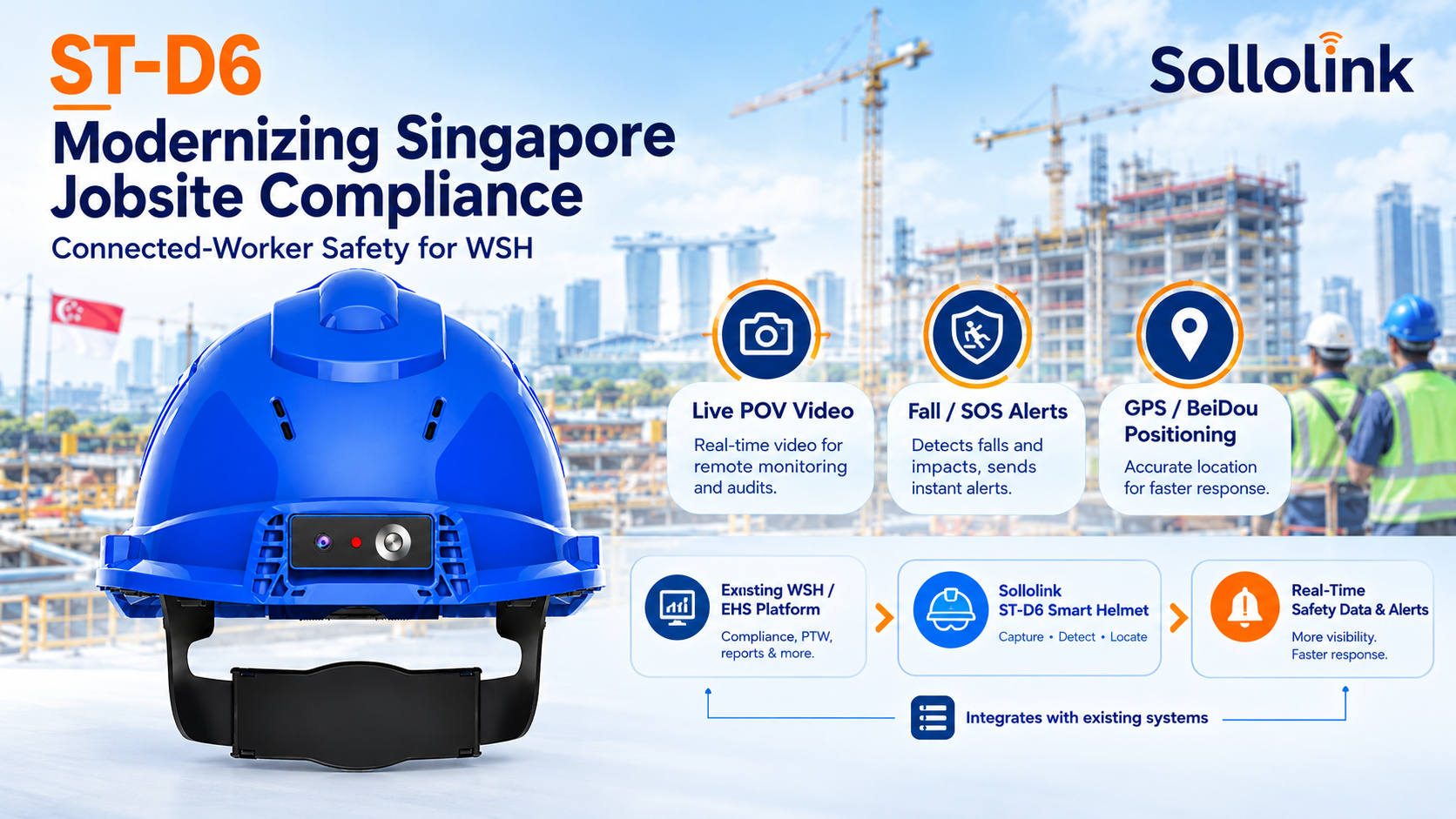
Meeting strict MOM standards requires shifting from reactive reporting to real-time awareness. SolloLink provides integrated safety solutions designed to bridge the gap between office-bound WSH management software and frontline execution.
EXISTING WSH PLATFORM
• Compliance Audit Logs
• Permit-to-Work Records
• Historical Reporting
SOLLOLINK CONNECTED WORKER LAYER
• Sub-Second Edge AI Fall & Man-Down SOS
• 1080P Live POV Video & Remote Audits
• GPS/BDS Spatial Tracking & Elevation
Key Capabilities of the SolloLink ST-D6 Smart Safety Helmet:
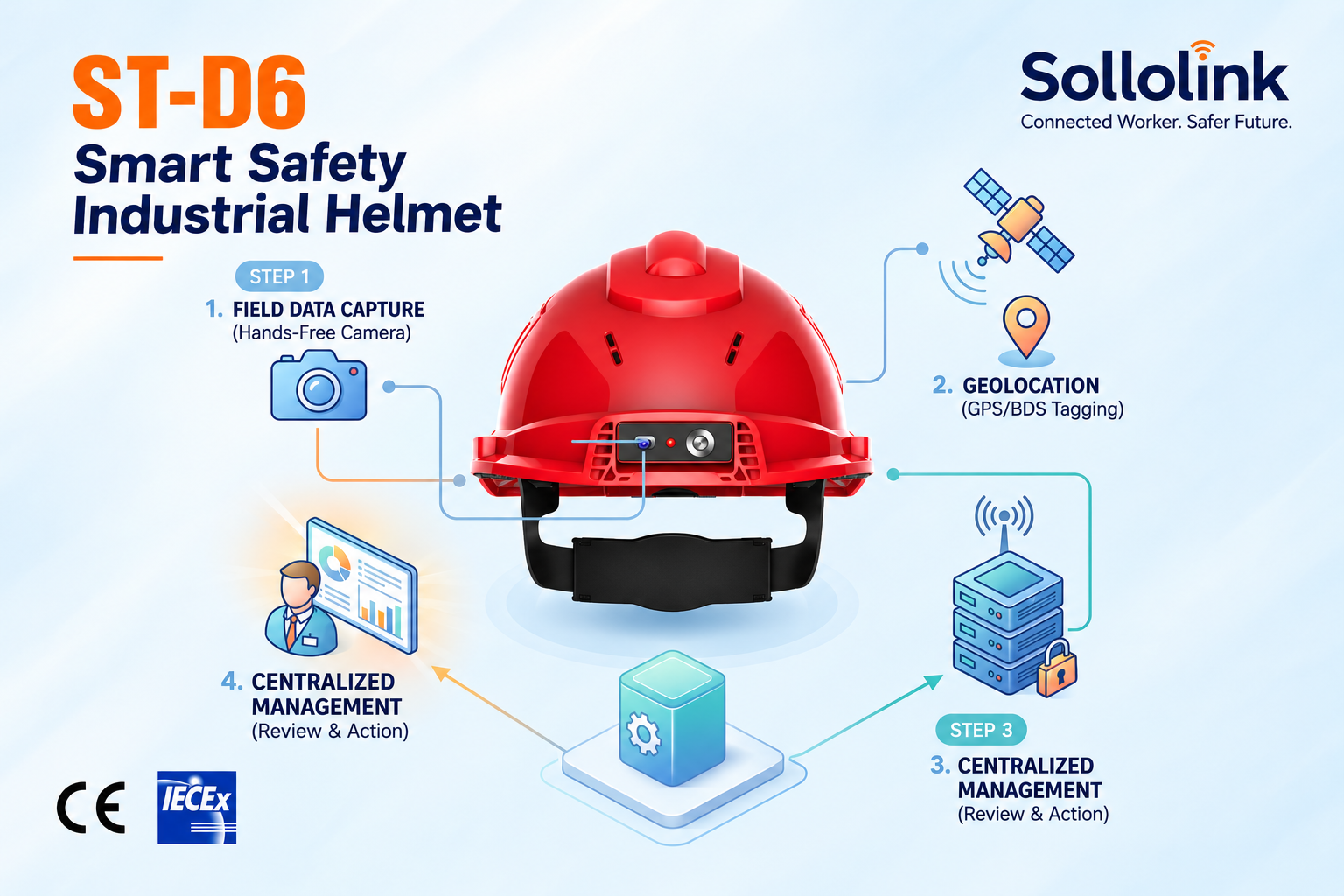
1080P Hands-Free Live POV Video: Empowers off-site safety directors to conduct remote visual audits and inspect complex rigging instantly, reducing physical travel overhead.
Automated Edge AI Fall Detection: Onboard motion algorithms detect high-G falls and sudden impacts, instantly dispatching SOS alerts with precise spatial coordinates.
Active High-Voltage EMF Proximity Alarms: Warn technicians via acoustic and haptic prompts before they breach approach boundaries near energized equipment.
Seamless Platform Integration: Natively supports open telematics protocols (Wialon, CMSV6, RTSP, and RESTful APIs), allowing system integrators to register devices directly via IMEI into existing dashboards with zero custom code.
4. Implementation Framework for Singapore Contractors
Evaluate Site Risks: Identify high-consequence activities such as work at height, lifting zones, and isolated operations.
Review Infrastructure: Assess site connectivity (4G LTE/Wi-Fi) and existing WSH management platforms.
Deploy a Targeted Pilot: Test the ST-D6 Smart Helmet within a designated high-risk zone to validate alert delivery, positioning accuracy, and battery performance under real operational conditions.
Integrate & Scale: Pair device IMEIs into your central EHS portal, establish automated escalation workflows, and expand deployment across regional projects.
5. Elevate Your WSH Compliance Today
Construction safety in Singapore demands real-time vigilance. By adding an active connected worker layer to your existing WSH infrastructure, your organization can move from reactive compliance to proactive incident prevention.
Connect your workers. Connect your safety data. Strengthen your WSH system.
#SingaporeConstruction #WSHSingapore #ConnectedWorker #SmartPPE #IndustrialIoT #Wialon #SolloLink #ST_D6 #WorkplaceSafety #ConstructionTech #OSHA
