
The Missing Human Layer in Middle East Smart Infrastructure
Across the Middle East, the built environment is undergoing an unprecedented digital transformation. From Saudi Arabia’s giga-projects and “Connected Construction” initiatives to Qatar’s massive smart city IoT deployments and Dubai’s landmark Digital Twin Platform, regional leaders are heavily investing in intelligent infrastructure.
While Building Management Systems (BMS) and IoT platforms successfully monitor energy consumption, HVAC equipment, and structural assets, a critical blind spot remains: the frontline workforce operating inside these environments.
Buildings and equipment are becoming smarter. Workforce safety must evolve to match.
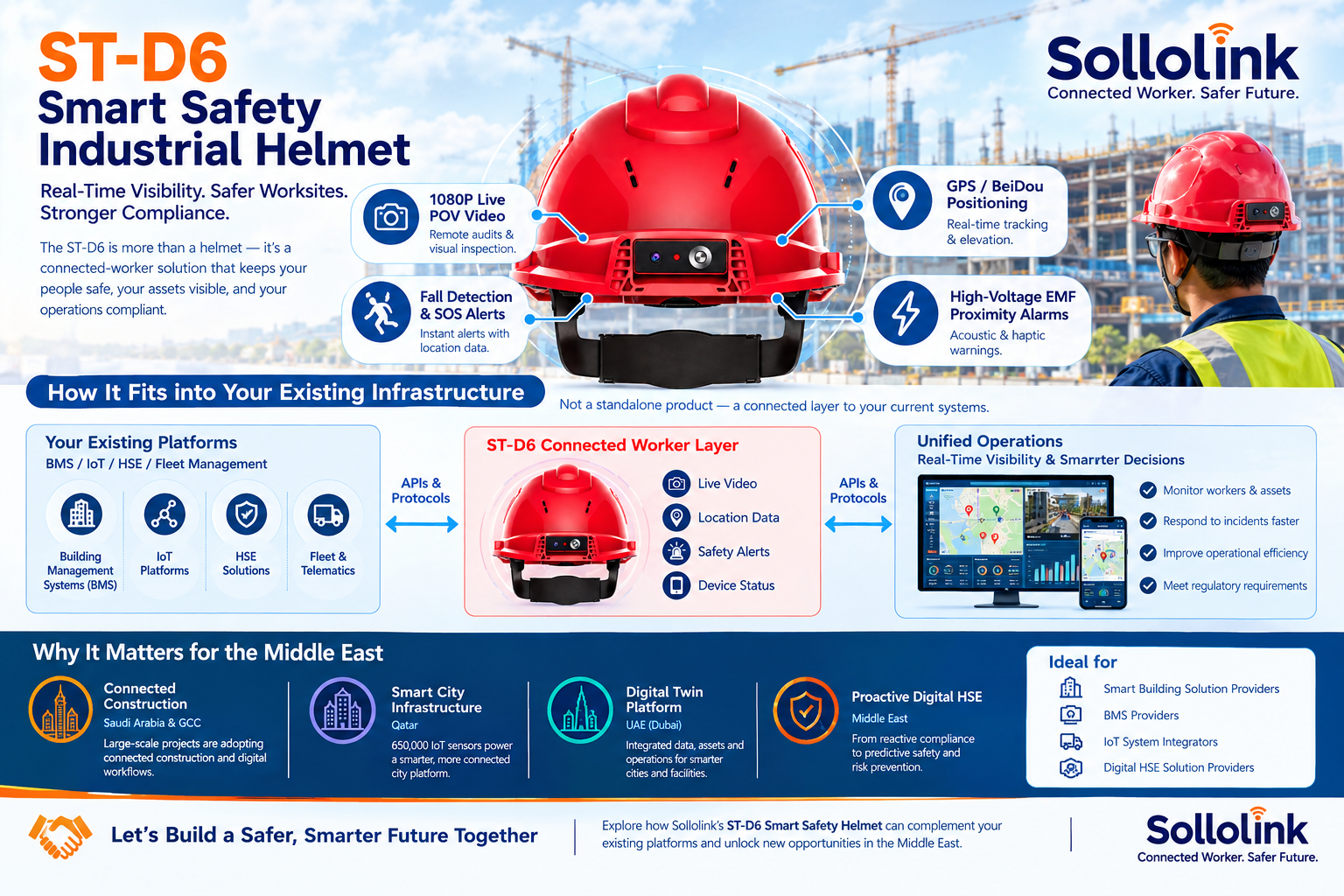
Sollolink bridges this gap by introducing an active connected-worker layer to existing smart infrastructure, combining industrial safety helmets with real-time IoT telemetry.
MIDDLE EAST SMART INFRASTRUCTURE
• BMS & HVAC Automation
• IoT Sensor Networks
• Digital Twin Platforms
SOLLOLINK CONNECTED WORKER LAYER
• Sub-Second Edge AI Fall & Man-Down SOS
• 1080P Live POV Video & Remote Guidance
• GPS/BDS Spatial Tracking & Geofencing
#SmartBuildingSolutionsMiddleEast #BMSIntegration #IoTSystemIntegrator#DigitalHSESolutions #IndustrialIoT#SaudiArabiaConstruction#GCCDigitalTransformation
1. Regional Market Drivers Across the GCC
-
Saudi Arabia & GCC: Transitioning toward “Connected Construction” by uniting project planning, machinery telematics, and field personnel under a single operational view.
-
Qatar: Expanding smart city frameworks—exemplified by massive IoT sensor networks—by extending telemetry beyond fixed infrastructure to mobile field assets.
-
UAE (Dubai): Leveraging official Digital Twin platforms to simulate real-time operations, where integrating live worker data enhances facility management and emergency readiness.
-
Digital HSE Evolution: Shifting from legacy, reactive paper audits toward proactive, predictive safety analytics and real-time hazard mitigation.
2. Introducing the Sollolink ST-D6 Smart Safety Helmet
The Sollolink ST-D6 transforms standard personal protective equipment (PPE) into an intelligent IoT edge terminal designed specifically for integration with existing enterprise software:
-
1080P First-Person Video: Empowers off-site engineers and facility managers to conduct remote visual audits and troubleshoot complex asset maintenance instantly.
-
Edge AI Fall & Man-Down Detection: Motion algorithms instantly detect high-G falls or sudden impacts, automatically dispatching SOS alerts with precise 3D spatial coordinates.
-
Active High-Voltage Proximity Warnings: Protects maintenance crews by triggering acoustic and haptic alerts before breaching safe approach boundaries near energized equipment.
-
Open API & BMS Integration: Natively supports open telematics protocols (Wialon, CMSV6, RTSP, and RESTful APIs), allowing system integrators to pair devices via standard IMEI registration with zero custom software overhead.
3. Value-Add for Regional System Integrators & BMS Providers
Sollolink partners directly with regional technology providers, empowering them to expand their existing portfolios:
-
For BMS & Smart Building Providers: Incorporate real-time technician positioning, emergency alerts, and field video feeds into existing facility management dashboards.
-
For IoT System Integrators: Add mobile wearable nodes to fixed sensor portfolios, creating a complete operational loop.
-
For Digital HSE Providers: Transition clients from passive compliance records to proactive, real-time safety monitoring.
Complete Your Digital Ecosystem Today
Connect your buildings. Connect your equipment. Connect your workers.
Contact Sollolink today to explore technical specifications, API integration pathways, and evaluation units for your upcoming regional projects.
#SmartBuildingSolutionsMiddleEast #BMSIntegration #IoTSystemIntegrator#DigitalHSESolutions #IndustrialIoT#SaudiArabiaConstruction#GCCDigitalTransforma
Frequently Asked Questions
1. What is connected-worker technology?
Connected-worker technology uses smart wearable devices, positioning, communication, and software integration to connect frontline employees with operational management systems. It can provide information such as worker location, emergency alerts, device status, and supported video functions.
2. Can Sollolink smart helmets integrate with existing BMS platforms?
Sollolink can explore integration with existing BMS environments through supported APIs and communication interfaces. The specific functions available depend on the target platform and technical requirements.
3. Can the ST-D6 smart helmet connect to an IoT platform?
Yes. The ST-D6 supports connected-device communication and project-specific integration. Supported information may include positioning, device status, and safety events, depending on the configuration and integration scope.
4. What industries can use Sollolink smart safety helmets in the Middle East?
Potential applications include construction, smart buildings, utilities, oil and gas, mining, power operations, industrial facilities, and infrastructure maintenance.
5. Can Sollolink support private-server deployment?
Private-server and customer-hosted deployment options can be evaluated according to project requirements. The data architecture, communication routes, security controls, and integration scope should be confirmed during technical assessment.
6. Can a system integrator incorporate Sollolink hardware into its own solution?
Yes. Sollolink welcomes technical discussions with system integrators and platform providers interested in incorporating connected-worker hardware and supported safety data into their own solutions.
tion
