
The Digital Transformation of Industrial Field Safety
Mining operations, petrochemical refineries, power utilities, and infrastructure sites represent some of the world’s most hazardous working environments. Field crews regularly navigate remote zones, extreme temperatures, heavy machinery corridors, and high-voltage electrical risks.
Traditional Personal Protective Equipment (PPE) provides essential kinetic impact defense. However, passive hard hats cannot communicate a technician’s spatial coordinates across a vast open-pit mine, stream live video during an equipment failure, or automatically request emergency dispatch when a lone worker falls unconscious.
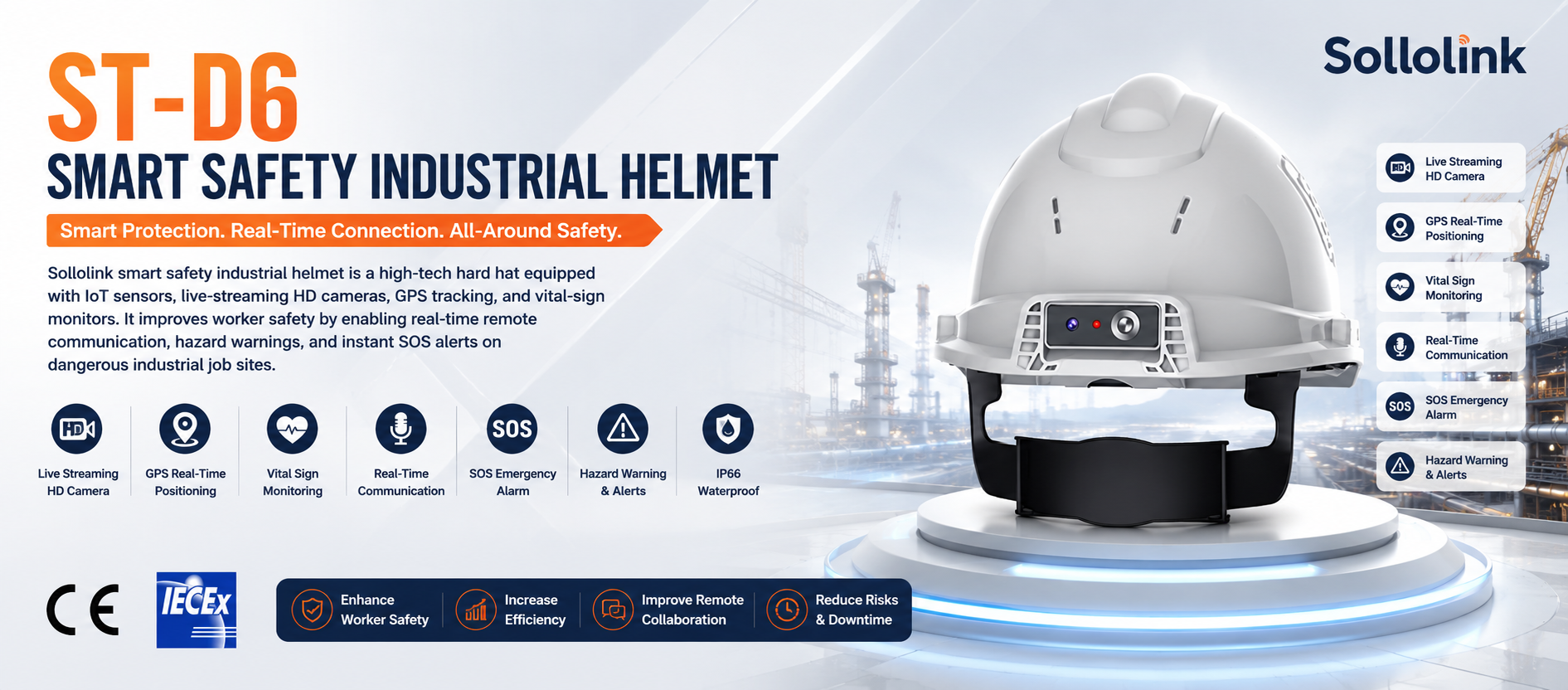
A connected worker safety solution bridges this critical operational gap. By integrating certified headwear with Industrial IoT (IIoT) sensors, high-definition video, GNSS spatial tracking, and cellular data networks, solutions like the Sollolink ST-D6 Smart Safety Industrial Helmet turn frontline personnel into connected, intelligent nodes within an enterprise EHS ecosystem.What Is a Connected Worker Safety Solution? A connected worker platform integrates smart wearables, field sensors, wireless telemetry, and enterprise software to create real-time visibility between frontline crews and central control centers.
1. Key Operational Capabilities:
1080P First-Person View (POV) Video: Streams live field conditions to off-site engineers for real-time remote audits and troubleshooting.
Multi-Constellation Positioning (GPS/BDS): Tracks workforce coordinates across expansive job sites with barometric 3D altitude tracking.
Automated Man-Down & Fall Alerts: Evaluates 6-axis motion dynamics to dispatch instant emergency SOS signals during worker trauma events.
Geofencing & Safety Zones: Generates immediate alerts if personnel enter unauthorized or hazardous work perimeters.
Full-Duplex Voice Communication: Connects distributed teams without requiring workers to hold extra handheld radios.
2. Why Mining and Oil & Gas Require Connected Wearables:
Heavy industrial environments present unique communication and safety obstacles that traditional safety workflows cannot address:
Expansive, Isolated Workzones: Technicians patrolling pipeline corridors or deep open-pit mines operate far from immediate supervision. Connected helmets ensure continuous spatial tracking and automated distress signaling.
Critical Response Windows: During severe gas releases, structural collapse, or high-G falls, seconds save lives. Integrated SOS triggers instantly transmit exact worker coordinates to emergency responders.
Visual Diagnostics over Voice: Describing a complex valve fault or PLC error over a two-way radio is prone to human error. Live video streaming enables off-site specialists to inspect equipment visually and provide step-by-step guidance.
Lone-Worker Risk Mitigation: Field personnel conducting lone inspections face unmonitored hazards. Continuous telemetry provides central control teams with real-time “heartbeat” safety visibility.
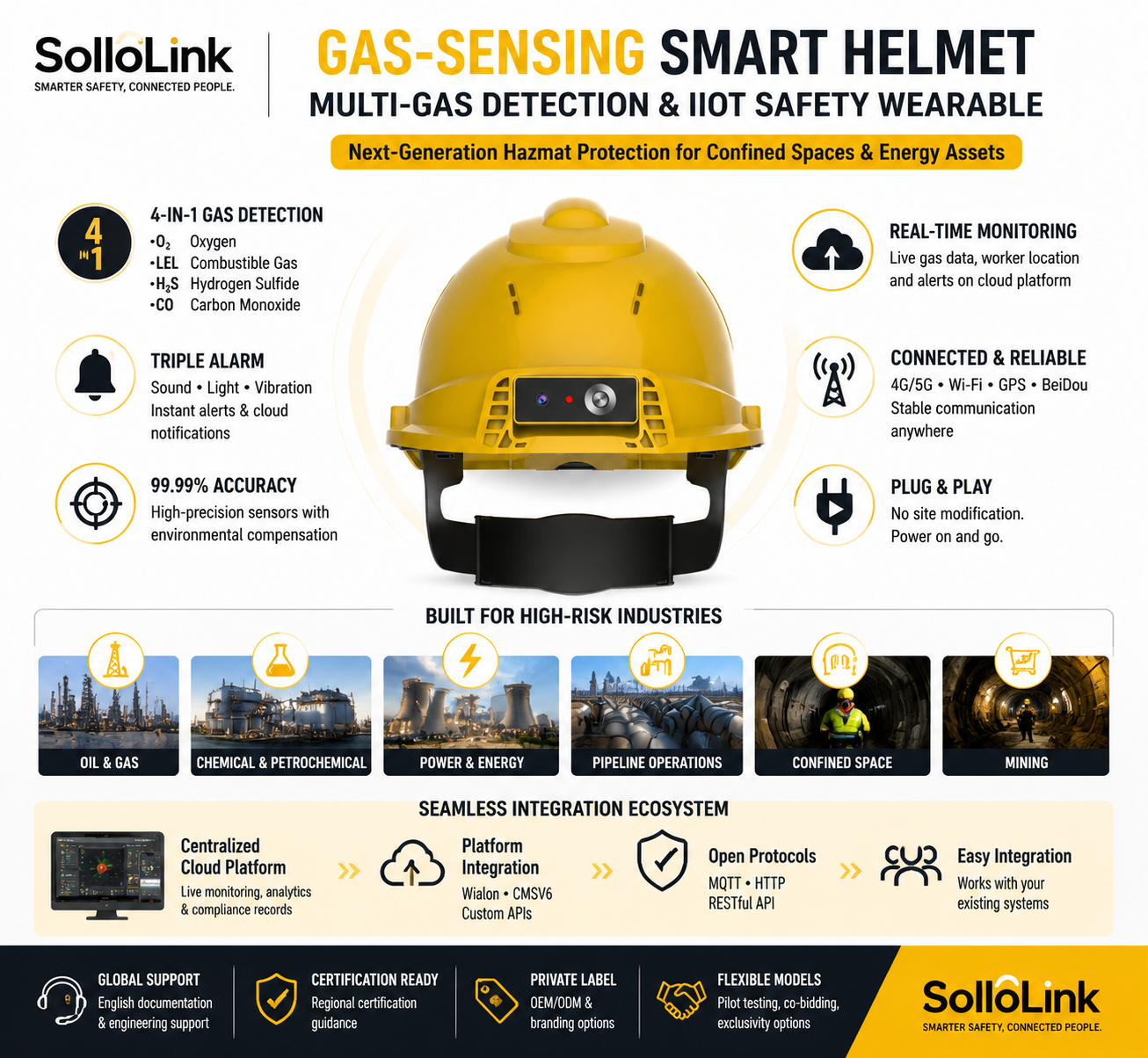
3. Enterprise Platform Integration (Wialon & CMSV6)A major hurdle in adopting industrial wearables is software fragmentation. Isolated devices that require standalone monitoring software create data silos and increase IT management costs.
The Sollolink ST-D6 addresses this with out-of-the-box compatibility for Wialon, CMSV6, RTSP, and open RESTful APIs. Enterprise integrators can register helmets directly via their unique IMEI numbers into existing fleet management dashboards—unifying vehicle tracking, heavy machinery monitoring, and frontline worker safety under a single pane of glass with zero custom software development.
4. Business Impact: The ROI of Connected Safety
Deploying an integrated connected worker solution yields measurable operational and financial returns:
30%–50% Slashed Downtime (MTTR): Off-site specialists inspect and guide field repairs in real time via live video, drastically reducing Mean Time to Repair.
Up to 70% Cut in Travel Overhead: Eliminates the need to send senior engineers to remote global sites for routine inspections or sign-offs.
10%–20% Lower Insurance Premiums: Insurance carriers routinely offer premium discounts for job sites implementing real-time connected worker monitoring.
Mitigated Legal Liability: Geotagged video and trajectory logs provide objective evidence during incident investigations.
5. Conclusion
The era of unmonitored, passive safety gear is over. Deploying a comprehensive connected worker safety solution like the Sollolink ST-D6 Smart Safety Industrial Helmet transforms frontline protective equipment into an active intelligence node—ensuring organizations detect risks faster, connect teams seamlessly, and achieve a zero-harm workplace.
6. Frequently Asked Questions (FAQs)
Q: What is a connected worker safety solution?
A: It is an integrated framework combining smart wearables (such as sensor-equipped helmets), IoT telemetry, spatial tracking, and software platforms to monitor worker safety, share live video, and coordinate emergency responses in real time.
Q: How does the ST-D6 smart helmet handle remote areas with limited cellular reception?
A: The ST-D6 features onboard micro-SD buffer memory that records video and telemetry locally during network dead zones, automatically syncing data back to the central platform once connectivity is re-established.
Q: Can the ST-D6 connect to our existing fleet management software?
A: Yes. The ST-D6 natively supports standard industrial protocols like Wialon and CMSV6, allowing system integrators to register helmets directly using their IMEI codes alongside existing vehicles and heavy machinery.
